

Ube powder draws you in with its purple colour and its softness, but you still need to know how to choose it and use it. A 100% ube powder can be recognised by its label, keeps best in a dry place, and works as well in a hot or iced ube latte as in desserts, with a few precautions worth knowing.
How do you choose and store a pure ube powder?
A pure ube powder is recognised first by its source plant, then by its label. Its quality finally depends on how you store it once the bag is opened.
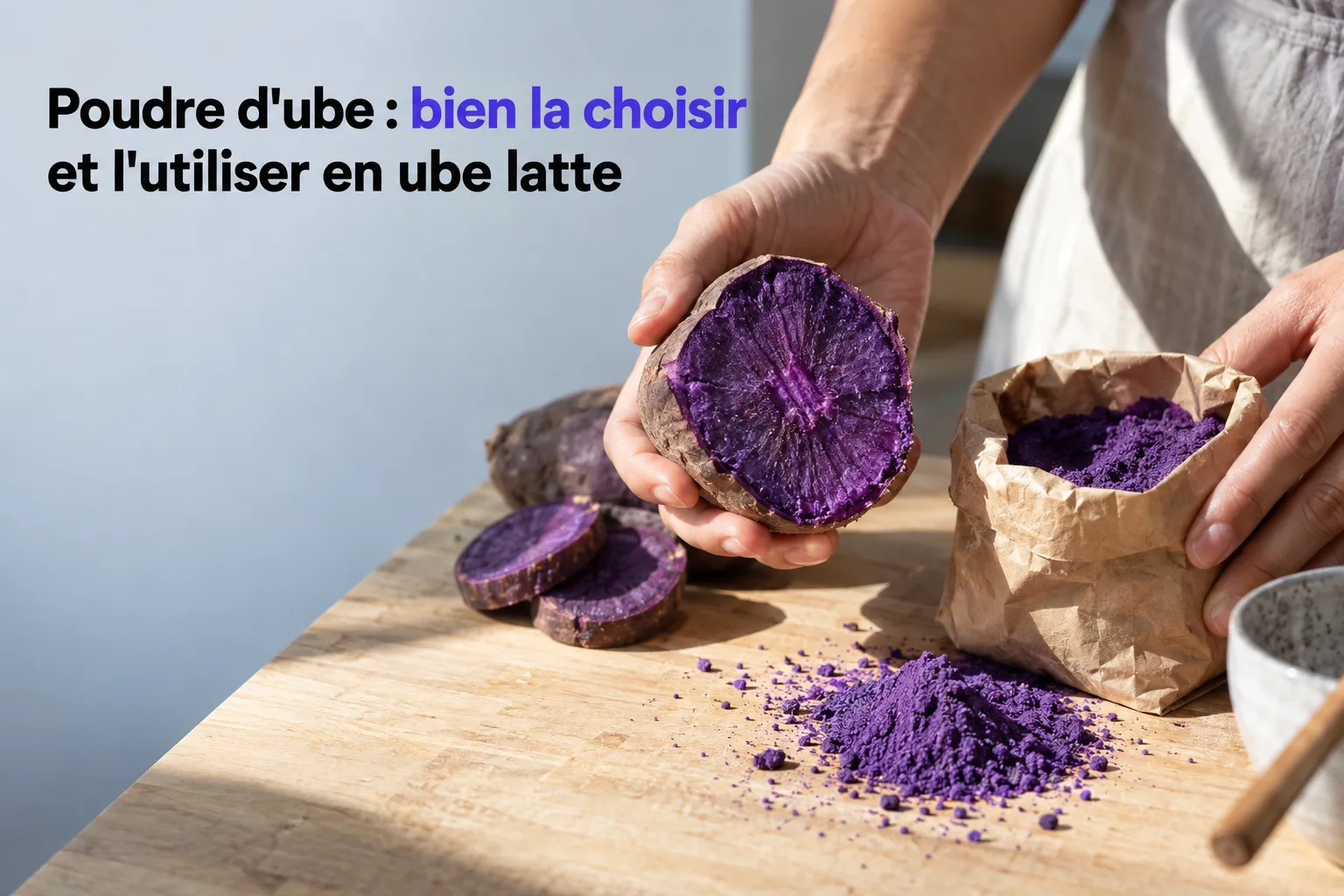
Recognising the purple yam and its powder
Ube is the tuber, that is, the underground storage organ, of the yam Dioscorea alata, grown notably in the Philippines. It should not be confused with the purple sweet potato (Ipomoea batatas) or with taro (Colocasia esculenta). Purple yam powder is obtained by drying and then grinding the tuber, sometimes pre-cooked: cultivar and process therefore change the shade, the fineness and the way it disperses in a liquid.
The difference comes down to flavour: a mild flavour, often described as slightly vanilla-like, with a roundness of hazelnut. VYTAL OYA sources the ube for its OYA Original ube powder from the Ilocos region in the Philippines, and follows each harvest from the fields to the finished product. Milled to 200 mesh, this powder offers a velvety texture that mixes easily.
Reading the ingredients, origin and labels
A single-ingredient powder lists only ube, purple yam or Dioscorea alata. Regulation (EU) No 1169/2011 on food information does indeed require, as the DGCCRF (the French consumer fraud authority) points out, that ingredients be declared in descending order of weight. In practice, this list matters far more than the word "ube" printed on the front of the pack.
- Blends: a powder made of 90% ube and 10% tapioca starch, or of 70% ube and 30% purple sweet potato, is not a 100% ube powder. Likewise, an added sugar, flavouring or colouring changes the nature of the product.
- Misleading wording: a latte mix or an "ube-flavoured" product does not guarantee that the tuber is the only ingredient.
- False clues: the words "fine powder" describe a texture, and an intense purple colour does not prove purity either.
Philippine origin should also be checked on the packaging; it cannot be deduced from the name. As for organic, Regulation (EU) 2018/848 has applied since 1 January 2022: the EU organic logo (Euro-leaf) may appear on a processed product containing at least 95% organic agricultural ingredients, without guaranteeing a 100% ube composition. VYTAL OYA powder contains a single ingredient, ube, and is vegan, gluten-free, with no added sugar, no colouring and no preservatives.
Keeping the powder fresh after purchase
Once the label checks out, storage takes over. VYTAL OYA indicates a shelf life of 24 months for its powder, but the best-before date and the instructions on each pack are what apply to the product you bought. By contrast, fresh tuber and cooked purée keep for much less time.
Moisture remains the main enemy: it clumps the powder and degrades its quality. So keep the bag closed in an airtight container, in a dry place, away from light and heat, and always dip a perfectly dry spoon into it.
How do you make an ube latte without lumps?
Properly stored, the powder lends itself first of all to the ube latte, a rounded drink with vanilla notes. It all rests on the same starting gesture: making a paste, common to both hot and iced versions.
Measuring and dissolving the powder
Measurements are not universal, and each powder has its own. VYTAL OYA recommends 1 teaspoon per serving, for 200 ml of milk or water, to be adjusted to the intensity you want. Another recipe uses 2 teaspoons, i.e. 8 g of its own powder, for 200 ml of milk: this equivalence does not hold for all powders.
- Pour: place the powder at the bottom of a bowl or glass.
- Dissolve: add a splash of hot water and stir in circular movements until you get a smooth paste.
- Top up: stir in the milk or water gradually.
This step of making a paste prevents lumps, since the powder is hydrated before being drowned in the liquid. The ube drink preparation guide details each step, from measuring to choosing the liquid.
Serving a hot version
For a caffeine-free break, pour the ube paste into hot milk, then stir or whisk before serving. Milk foam is optional: it adds an airy texture.
Dairy milk as well as oat, almond or coconut drinks all work. A pure powder does not require sweetening: a touch of vanilla, cinnamon, honey or agave syrup is enough, depending on your taste.
Making an iced version
The cold version starts the same way: the powder is dissolved in a little hot water. This paste is then poured over cold milk and ice cubes, to be stirred or left in layers for the visual effect.
A variation for a tall glass combines 2 teaspoons of powder and 100 ml of hot water. It adds 150 ml of hazelnut drink, which highlights the roundness of the ube; a teaspoon of maple syrup or whole cane sugar and a little cocoa are optional.
VYTAL OYA also suggests simply adding the dissolved mixture to cold water or milk, then a few ice cubes.
How do you use ube powder in cooking?
Beyond the cup, ube powder colours and flavours many recipes, from breakfast to evening dessert. It fits as well into raw preparations as into baked batters.
Flavouring drinks and desserts
Knowing how to use ube powder day to day often starts with cold preparations, which require no cooking. The amount then depends on the preparation and the intensity you are after.
- Smoothies and breakfast: blend the powder with a banana, a plant-based drink and red berries, or add it to a milkshake, yoghurt or porridge.
- Purple desserts: custards, icings, ice creams, flans and fillings take on its hue and its vanilla notes.
- Savoury cooking: ube can also be served as a purée, with steamed vegetables or whole grains.
These simple uses let you dose the powder to your taste before moving on to the oven, where heat changes its result a little.
Adding it to baking recipes
In baking, the powder is added to pancake, crêpe or cake batters. The four VYTAL OYA recipes below each use 2 teaspoons, with cooking times adapted to each format.
- Pancakes: the powder goes into the smooth batter for 8 to 10 pancakes, cooked 1 to 2 minutes on each side in a lightly oiled pan.
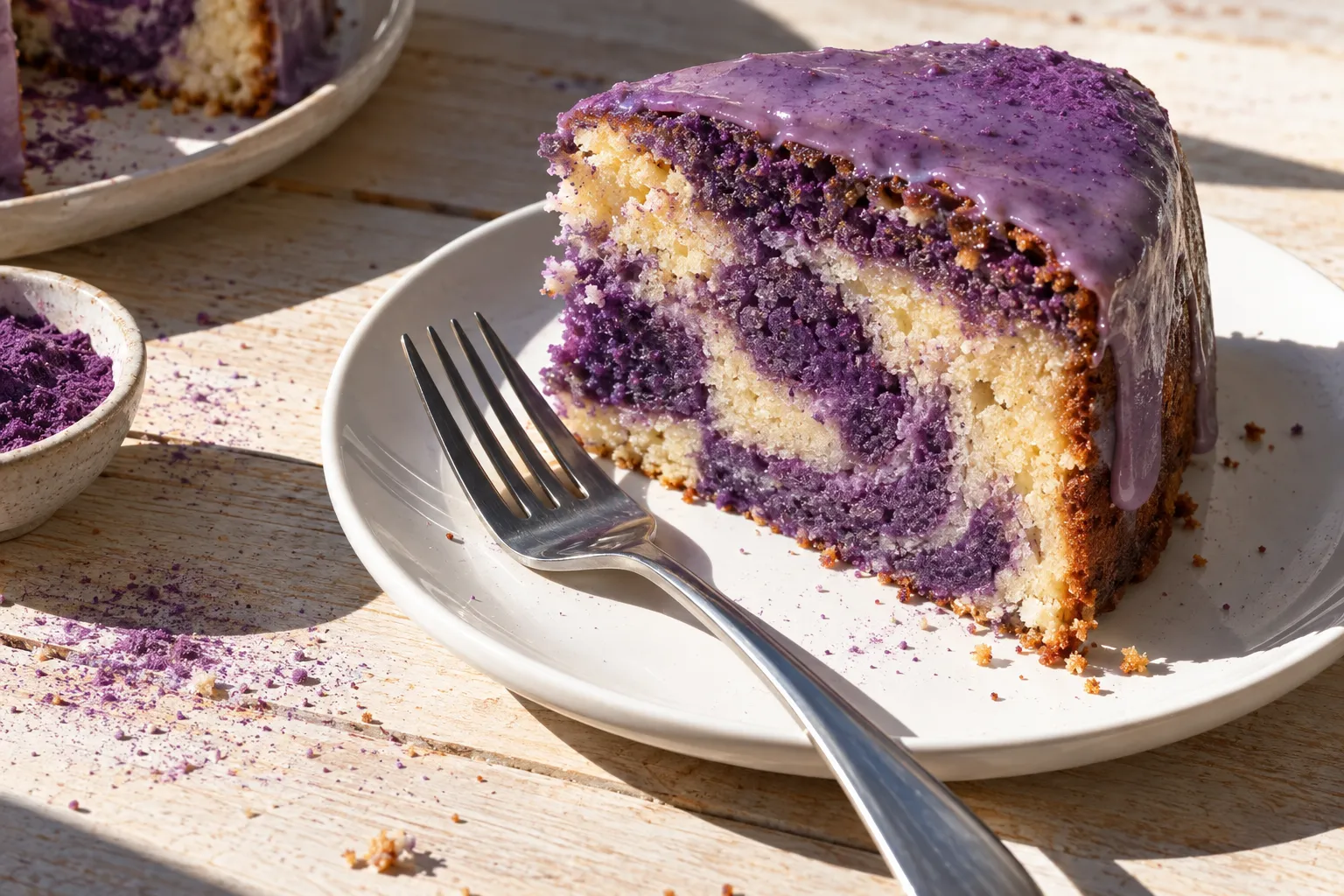
- Marble cake: serves 6 to 8; the powder flavours one half of the batter, poured in alternation with the other, then baked for 40 to 45 minutes at 180 °C.
- Brownies: the powder is added after the flour and salt, for 20 to 25 minutes of baking at 180 °C.
- Cookies: it goes into the dough before the chips for 10 to 12 cookies, baked 10 to 12 minutes at 180 °C.
In the oven, the purple colour remains visible but may soften depending on temperature and time. These delicious ube recipes also suit vegan baking, where ube complements or replaces other flavouring ingredients.
Adapting a purée-based recipe
Many Filipino recipes start from a moist form of ube. Yet dry powder, purée, commercial paste and extract do not bring the same water or necessarily the same ingredients; ube halaya, for its part, is a moist, often sweetened preparation.
Replacing a purée with the same weight of powder therefore changes the final texture. Rehydrate the powder, then adjust the other liquids in the recipe.
One manufacturer suggests about 40 g of powder and 145 ml of water to replace 250 g of purée. This ratio depends on the product: it is a starting point, not a universal conversion.
Nutrition and precautions for ube powder
From latte to cake, ube powder remains a food, with its contributions and its limits. It is best to know them so you can enjoy it with peace of mind throughout the day.
Understanding its benefits and limits
Ube provides, among other things, starch, fibre and minerals. According to the VYTAL OYA nutrition table, a 5 g serving of powder provides 1.75 g of fibre and 0.8 g of protein. It also contains 2.5 mg of salt.
- Anthocyanins: these pigments give certain cultivars their colour; a 2015 study measured their antioxidant activity in the laboratory, without demonstrating any medical effect after an ube latte.
- Carbohydrates: the powder provides some, and no universal glycaemic index has been established for it.
- Research: the biological activities studied in purple yam remain to be confirmed.
Presenting ube as rich in antioxidants is therefore not enough to prove health benefits of ube powder. A 2026 scientific review on Dioscorea alata also stresses that these activities still require scientific and clinical validation.
Telling caffeine apart from gluten-free
A powder made solely of ube does not naturally contain caffeine, unlike matcha, which comes from tea leaves. The matcha latte and the ube latte therefore meet different cravings. However, an added espresso or matcha makes the drink caffeinated: the final recipe decides.
Ube is not a gluten-containing cereal, but a person with coeliac disease should also check the other ingredients and the risk of cross-contamination. Under Regulation (EU) No 828/2014, applicable since 20 July 2016, the "gluten-free" claim requires a maximum of 20 mg of gluten/kg in the food as sold.
Knowing the dietary precautions
The fresh tuber is always cooked before being eaten. This rule does not extend to a commercial powder already cooked during manufacture, since processes differ from one product to another.
The main contraindication for ube powder concerns people who have already reacted to yam or to Dioscorea: they should avoid it and seek medical advice. The available studies do not allow this allergy risk to be quantified.
A 1994 study measured 486 to 781 mg of oxalates per 100 g of dry matter in the cultivars examined. These values do not apply to all powders; in case of a history of calcium oxalate kidney stones or a specific diet, medical or dietary advice is appropriate.
Give your ube latte a vanilla touch
Naturally sweet, with vanilla and hazelnut notes, our 100% ube powder slips into your hot or iced lattes as well as your desserts.


